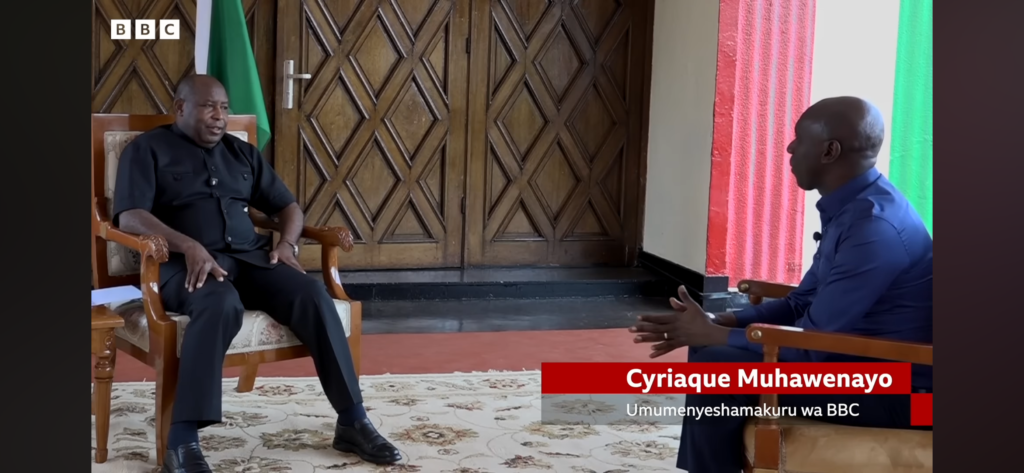

During an interview on the MAIN SWITCH 257 program, broadcast by Buja TV and published on YouTube Tuesday, June 2, 2026 , Burundi’s President, Évariste Ndayishimiye, stated that Burundi has oil in the Rukoko Plain and beneath Lake Tanganyika.. The remarks came at a time when the country continues to face recurring fuel shortages and growing public debate over domestic energy resources.
Andika Check reviewed available geological studies, exploration records, scientific publications, and official reports to determine whether there is evidence that Burundi possesses commercially exploitable oil reserves.
The Claim
In the Buja TV interview, President Ndayishimiye presented oil as one of the natural resources available in Burundi, specifically referring to Rukoko and Lake Tanganyika.
The key question is not whether hydrocarbons have ever been detected in the region. The key question is whether there is evidence that Burundi has proven and commercially exploitable petroleum reserves.
What the Evidence Shows
Geologists have long considered the Lake Tanganyika basin a potentially promising petroleum region because it lies within the western branch of the East African Rift System.
Scientific research has documented natural hydrocarbon seepages and geological formations that may generate petroleum. Studies of the basin conclude that hydrocarbon indicators exist and warrant further exploration.
In addition, petroleum exploration interest in the Lake Tanganyika basin is not new. Exploration blocks have been licensed in the past, reflecting the belief that the basin could contain hydrocarbons.
Indicators Are Not Proven Reserves
The existence of oil traces or hydrocarbon seepages does not prove the existence of commercially recoverable oil reserves.
In the petroleum industry, a commercial discovery requires:
- Seismic surveys;
- Exploratory drilling;
- Reserve certification;
- Economic feasibility studies.
None of the publicly available sources reviewed by Andika Check show that Burundi has completed the process required to confirm commercially exploitable oil reserves in either Rukoko or the Burundian section of Lake Tanganyika.
No Public Proof of Commercially Exploitable Oil
Andika Check found no publicly available drilling results, reserve certification documents, or internationally recognized petroleum assessments demonstrating that Burundi possesses commercially recoverable oil reserves.
This distinction is crucial.
In fact, numerous regions around the world have shown promising geological indicators but never developed into producing oil fields.
What About Lake Tanganyika?
The broader Lake Tanganyika basin continues to attract scientific and exploration interest. Researchers and regional authorities acknowledge petroleum potential in the basin.
However, potential is not proof.
Available evidence indicates that exploration has identified promising geological conditions, but publicly available data do not confirm a commercially viable oil discovery on the Burundian side of the lake.
Verdict
Andika Check found evidence that hydrocarbon indicators exist in the Lake Tanganyika basin and that the region has long been considered a potential petroleum province.
However, we found no publicly available evidence confirming commercially exploitable oil reserves in either the Rukoko Plain or Burundi’s portion of Lake Tanganyika.
Therefore, President Évariste Ndayishimiye’s claim that Burundi has oil in Rukoko and Lake Tanganyika is not supported by publicly available evidence if interpreted as a claim of proven, commercially exploitable petroleum reserves.
The most accurate conclusion is that Burundi has documented hydrocarbon indicators and petroleum potential, but the existence of commercially exploitable oil reserves remains unproven.
————
Sources
- Buja TV Interview: https://www.youtube.com/watch?v=H5SQoxBi2Bg&t=1s
- ResearchGate – Oil Seepages as Potential Leads for Hydrocarbon Exploration in Lake Tanganyika: https://www.researchgate.net/publication/377336221_Oil_seepages_as_potential_leads_for_hydrocarbon_exploration_in_Lake_Tanganyika
- Oil & Gas Journal – Burundi Lake Tanganyika Exploration Eyed: https://www.ogj.com/home/article/17267044/burundi-lake-tanganyika-exploration-eyed
- IWACU – Experts Prospected for Oil Indices in Lake Tanganyika: https://www.iwacu-burundi.org/englishnews/experts-prospected-for-oil-indices-in-lake-tanganyika-says-minister-of-energy/
——
Sisi Da Silva from Main Switch 257 of Buja TV and Évariste Ndayishimiye, President of Burundi during the interview © ARR