
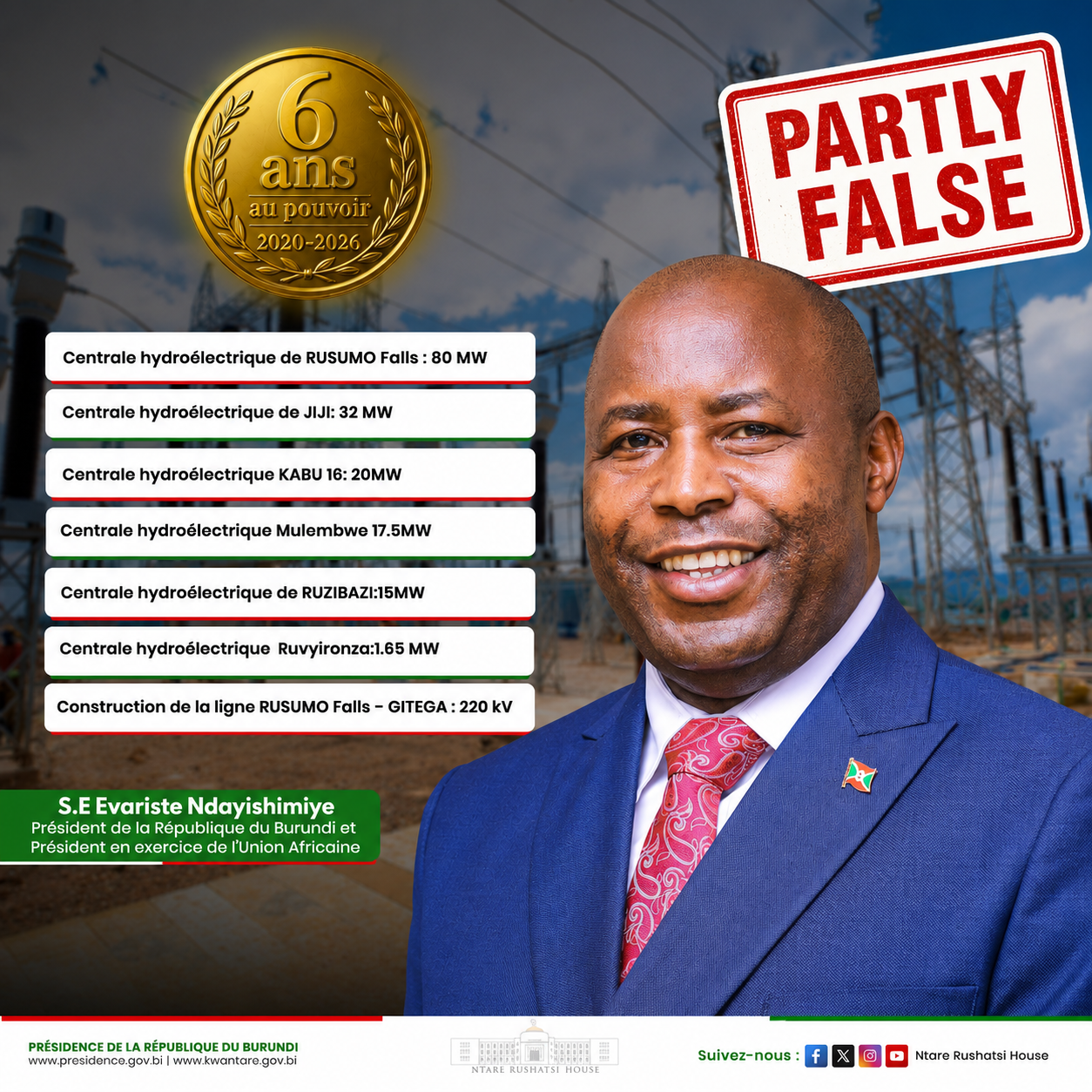
To mark six years since President Évariste Ndayishimiye took office, Burundi’s Presidency released a graphic highlighting seven hydropower projects as major achievements of his administration. The visual, published by Ntare House on June 18, 2026, showcases the Rusumo Falls, Jiji, Kabu 16, Mulembwe, Ruzibazi, and Ruvyironza hydroelectric plants, alongside the Rusumo Falls–Gitega transmission line, presenting them as evidence of the government’s progress in addressing the country’s long-standing electricity shortage.
While President Ndayishimiye has overseen the completion of several of these projects, available public records show that—with one notable exception—most were conceived, financed, and launched before he assumed office in June 2020, during the presidency of the late Pierre Nkurunziza.
What the records show
A review of project documentation, financing agreements, construction timelines, and official announcements indicates that Ruvyironza is the only hydropower project among those highlighted that was initiated entirely during President Ndayishimiye’s tenure.
Developed by Songa Energy, construction of the 1.65-megawatt (MW) Ruvyironza plant began in May 2023 and was completed in April 2025, before its official inauguration in November 2025.
By contrast, the remaining projects had already entered their planning or construction phases under the previous administration.
| Hydropower Project | Capacity | Construction Began | Commissioned/Inaugurated | Administration That Launched the Project |
|---|---|---|---|---|
| Rusumo Falls | 80 MW (26.5 MW allocated to Burundi) | March 2017 | February 2026 | Pierre Nkurunziza |
| Jiji | 32.5 MW | 2013 (preparatory works); major construction 2019 | June 2025 | Pierre Nkurunziza |
| Mulembwe | 17 MW | 2020 | June 2026 | Pierre Nkurunziza |
| Kabu 16 | 20 MW | 2011 (planning); construction 2017 | October 2024 | Pierre Nkurunziza |
| Ruzibazi | 15 MW | 2019 | September 2022 | Pierre Nkurunziza |
| Ruvyironza | 1.65 MW | May 2023 | November 2025 | Évariste Ndayishimiye |
Collectively, the projects highlighted by the Presidency represent approximately 146 MW of installed capacity. Ruvyironza accounts for roughly 1.1% of that total.
Completion versus initiation
This distinction does not diminish the significance of completing large-scale infrastructure projects. Bringing complex energy projects to completion requires continued financing, political commitment, coordination among contractors, and government oversight.
However, presenting these projects without distinguishing between project conception, financing, construction, and completion risks creating the impression that they were entirely initiated under the current administration. Public records indicate that the overwhelming majority originated before President Ndayishimiye took office.
The missing project: Mpanda
One notable omission from the presidential communication is the Mpanda Hydropower Project in Bubanza Province.
Its absence is significant because Mpanda has become one of Burundi’s most prominent stalled infrastructure projects.
During a visit to the construction site on October 15, 2021, President Ndayishimiye publicly criticized the project’s management after more than 54 billion Burundian francs had already been spent on works that had effectively stopped in 2017.
“It is a shame. As President, I am ashamed,” Ndayishimiye said during the inspection.
He subsequently ordered an investigation into the project.
More than four years later, however, construction has yet to resume, and authorities have not publicly accounted for the funds already invested. The project remains absent from recent official narratives highlighting progress in the energy sector.
More generating capacity, but persistent power outages
Another question is whether the additional generating capacity has translated into reliable electricity for households and businesses.
Evidence suggests that significant challenges remain.
In August 2025, Bujumbura experienced one of its longest electricity outages in recent years. For more than ten days, hospitals, banks, businesses, and households faced severe disruptions. UNICEF supplied an emergency generator to Prince Regent Charles Hospital to maintain essential services during the blackout.
These events illustrate that increasing electricity generation alone does not automatically resolve supply shortages.
The Director General of REGIDESO, Burundi’s national water and electricity utility, has argued that electricity production is becoming increasingly adequate but that the country’s principal constraint is an aging transmission and distribution network, much of which dates back to the 1960s.
Business groups have echoed these concerns. According to PARCEM Burundi, several export-oriented industries report operating at roughly 60% of production capacity, and in some cases even less, because of unreliable electricity supply.
National targets remain distant
The government frequently cites Burundi’s Vision 2040–2060 when discussing infrastructure achievements.
The strategy sets ambitious electrification targets:
- 70% national electrification by 2030
- 100% national electrification by 2040
Despite recent investments, Burundi remains well below those objectives.
Although Burundi’s estimated hydropower potential is approximately 1,700 MW, fewer than 200 MW are currently being exploited—about 12% of the country’s estimated capacity.
The newly completed projects therefore represent important additions to the national grid but also underscore the scale of investment still required to achieve universal electricity access.
Verdict
The Presidency is correct in highlighting the completion of several major hydropower projects during President Évariste Ndayishimiye’s administration. These projects have increased Burundi’s electricity generation capacity and constitute significant infrastructure milestones.
However, available evidence shows that most of the projects showcased were initiated, financed, and launched under President Pierre Nkurunziza’s administration, with Ruvyironza being the principal project that originated during the current presidency.
The official communication also omits the stalled Mpanda Hydropower Project, despite its importance in Burundi’s recent energy history.
Finally, while installed generating capacity has increased, persistent electricity outages, an aging transmission network, low national electrification rates, and significant untapped hydropower potential indicate that Burundi’s energy challenges remain far from resolved.
Taken together, the evidence suggests that the presidential communication presents a selective account of Burundi’s energy sector, emphasizing project completions while providing limited context on when those projects began and the structural challenges that continue to affect electricity access across the country.
———–
Photo: The flyer published by Ntare House on June 18, 2026
Sources
- Presidency of Burundi (Ntare House), official Facebook, June 18, 2026.
- World Bank, Jiji and Mulembwe: Channeling Hydropower to Drive Burundi’s Sustainable Energy Growth.
- African Development Bank project documentation on Jiji-Mulembwe.
- Nile Equatorial Lakes Subsidiary Action Program (NELSAP), Rusumo Falls Hydroelectric Project.
- Iwacu Burundi reporting on the Mpanda Hydropower Project and the 2025 electricity crisis.
- Jimbere Magazine interviews with REGIDESO and PARCEM Burundi.
- Songa Energy project documentation on Ruvyironza Hydropower Plant.
- Le Renouveau