Official communications, including from the Bank of the Republic of Burundi (BRB, present the 2026 IMF Article IV consultation as confirmation that Burundi’s economy is stabilizing and on a positive trajectory.
Both the IMF and the BRB agree that Burundi has made real macroeconomic progress. However, the IMF also highlights significant risks and structural distortions, meaning the recovery remains partial and conditional rather than complete.
Key sources
- International Monetary Fund (International Monetary Fund) Article IV Consultation – Burundi (May 18, 2026)
https://www.imf.org/en/Countries/BDI - Bank of the Republic of Burundi (BRB) communiqué on IMF Article IV conclusions (May 21, 2026)
https://www.brb.bi/node/3359
What the IMF says (independent assessment)
Macroeconomic improvements confirmed
The IMF reports that Burundi has taken “important policy steps to stabilize the economy and reduce imbalances.”
It confirms:
- GDP growth: 4.2% in 2025
- Inflation: from 45.5% (April 2025) to 10.8% (March 2026)
- Fiscal deficit: narrowing to 3.4% of GDP
- Public debt: 42% of GDP, assessed as sustainable but vulnerable
IMF statement: “Growth accelerated in 2025 and inflation declined sharply.”
Key IMF warnings
Despite progress, the IMF stresses:
“Large external imbalances leave Burundi’s economy vulnerable to a worsening of external conditions.”
It also highlights:
- A 100% gap between official and parallel exchange rates
- High risk of debt distress
- Continued foreign exchange shortages
- Need for gradual exchange rate reform
IMF conclusion: “Macroeconomic stabilization is attainable, provided reforms are sustained.”
What the BRB says (official national position)
The BRB communiqué broadly confirms the IMF’s positive assessment, emphasizing policy ownership and ongoing reforms.
BRB-aligned points
The BRB highlights:
- Improvement in macroeconomic stability indicators
- Decline in inflation pressures
- Fiscal discipline efforts
- Progress in monetary policy management
- Commitment to continued reforms
The central bank presents the IMF report as validation of Burundi’s stabilization strategy, while stressing that reforms are part of a national economic agenda.
Emphasis difference (important)
While the IMF stresses risks and conditionality, the BRB communiqué focuses more on:
- Achieved stabilization progress
- Policy continuity
- Institutional reform efforts
- Positive macroeconomic trajectory
Side-by-side comparison
| Issue | IMF assessment | BRB position |
| Inflation | Falling but not stable | Improving |
| Growth | Moderate (~4%) | Positive and improving |
| Exchange rate | 100% distortion remains | Reform underway |
| Debt | Sustainable, high risk | Managed prudently |
| Outlook | Conditional, uncertain | Broadly positive |
| Risks | High external vulnerability | Less emphasized |
Key fact-check findings
✔ Confirmed by both IMF and BRB
- Inflation has significantly declined
- Economic growth is positive (~4%)
- Fiscal discipline has improved
- Export performance (gold/coffee) strengthened macro indicators
Confirmed by IMF but less emphasized by BRB
- Exchange rate gap of around 100%
- High risk of debt distress
- Foreign exchange constraints
- External vulnerability to shocks
- Conditional nature of recovery
Important context missing from simplified narratives
- Inflation decline does not reverse past price increases
- Growth remains below structural transformation targets
- FX shortages still affect imports and liquidity
- Recovery depends heavily on sustained reforms
Final verdict
The IMF Article IV report and the BRB communiqué are not contradictory, but they emphasize different aspects of the same reality.
- The BRB highlights progress and stabilization gains
- The IMF emphasizes risks, constraints, and conditions for sustainability
The most accurate interpretation is that Burundi is experiencing macroeconomic stabilization in progress, not full economic recovery.
The IMF confirms that Burundi’s economy is stabilizing, but it also clearly states that the recovery is fragile, conditional, and exposed to significant external risks. The BRB communication reflects this progress, but places less emphasis on the underlying vulnerabilities.
_____
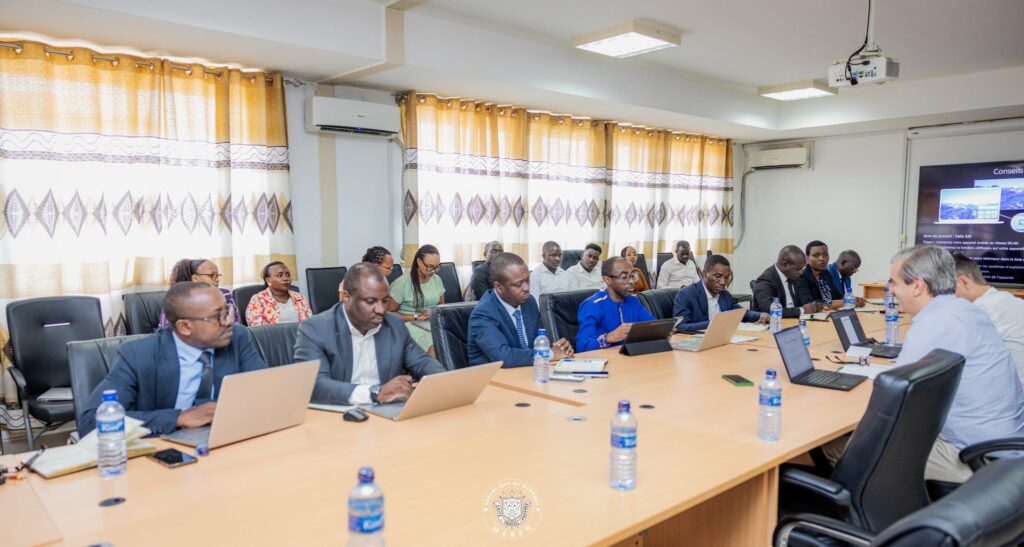
Photo: Meeting between the IMF mission and the Burundian economic authorities in May 2026. © Burundi Ministry of Finances